
Elevator Safety in High-Rises: Who Is Legally Liable for Injuries Caused by Malfunctioning Lifts in Housing Societies

Abstract Rapid urbanization has led to the construction of high-rise residential buildings across India, making elevators an indispensable part of daily life. While elevators provide convenience, accidents caused by malfunctioning lifts have become increasingly common, resulting in serious injuries and fatalities. Such incidents raise crucial legal questions regarding liability and compensation. Determining responsibility often […]
PRIVATE SECTOR WHISTLEBLOWERS IN INDIA

PRIVATE SECTOR WHISTLEBLOWERS IN INDIA Introduction In the year 2003, engineer Satyendra Dubey was killed after revealing fraud in the Golden Quadrilateral road project, while marketing manager Shanmugam Manjunath was assassinated after locking petrol pumps to prevent adulteration of fuel. Both these individuals were working in the public sector, and their murders led to […]
GRATUITY CLAIM DENIED? Knowing Your Statutory Rights to Receive Gratuity After Five Years of Continuous Service An Examination of the Payment of Gratuity Act, 1972 and the Code on Social Security, 2020 A Legal Essay

PREFACE: Meena Devi worked the assembly line in an auto-components factory in Faridabad for four years as a “temporary” for 11 months each before her supervisor would mention supporting her for permanency at the end of each month, and she would sign on the regular rolls for another year. HR said that the termination of […]
International Commercial Arbitration: Enforcement Challenges and Jurisprudential Divides.

“International Commercial Arbitration: Enforcement Challenges and Jurisprudential Divides.” Introduction: The Promise and the Practice International commercial arbitration is often introduced to law students as the great equaliser of cross-border dispute resolution. It establishes a neutral forum, a single binding award, and due to the presence of the New York Convention, there lies near-universal enforceability. The […]
Your Medical Records Aren’t Just the Hospital’s — Here’s What Indian Law Says About Your Health Data Rights

Here’s the full text — just select and copy: Health Data Privacy: Knowing Your Rights Over Your Digital Health Records in Indian Hospitals A patient’s guide to digital privacy rights under India’s evolving data protection law Why Your Medical Records Deserve a Second Look Think about the last time you walked into a hospital. Maybe […]
Fake Notices from Electricity Board and IT Department: How to Verify and Legally Report Fraudulent Notices and SMS

Introduction It is around 7 PM. You get an SMS that reads: “Dear consumer, your electricity connection will be disconnected tonight at 9 PM due to non-payment of dues. Call immediately on 9XXXXXXXX to avoid disconnection.” You panic. You call the number. A man on the other end asks for your bank account details or […]
The Business of Entertainment Law: Commercial Contracts Behind Films, Music, and OTT Platforms

The Business of Entertainment Law: Commercial Contracts Behind Films, Music, and OTT Platforms Introduction The Indian entertainment industry, spanning film, music, and, most recently, over-the-top (OTT) streaming, has evolved from a business historically driven by informal understandings and personal relationships into one governed by increasingly sophisticated commercial contracts. This shift has been propelled by the […]
International Commercial Arbitration in India: Possibilities, Obstacles, and the Road Ahead

International Commercial Arbitration in India: Possibilities, Obstacles, and the Road Ahead Introduction The quest for establishing India as a favored place for international commercial arbitration has been a topic that has been on the agenda in India’s law and economic policy circles for well over two decades. The increasing complexity of international business along with rising number of disputes arising across borders has resulted in arbitration being the automatic choice for sorting out disputes. India, with its rapidly expanding economy, growing foreign investment, and deepening integration into global supply chains, has recognised that a robust arbitration ecosystem is not a luxury but a necessity. Yet the journey from aspiration to reality has been uneven — marked by significant legislative reform, judicial course-correction, and persistent structural challenges that continue to test the confidence of international parties. This article examines the opportunities that India’s arbitration framework presents, the obstacles that remain, and the reforms necessary to position India as a genuine hub for international commercial arbitration. The Legislative Foundation: The Arbitration and Conciliation Act, 1996 India’s modern arbitration regime is anchored in the Arbitration and Conciliation Act, 1996, which was enacted to align domestic law with the UNCITRAL Model Law on International Commercial Arbitration. The Act was a deliberate attempt to modernise a fragmented and outdated framework inherited from three separate colonial-era statutes, and to signal India’s commitment to internationally accepted arbitration standards. Since 1996, the Act has undergone substantial amendments — most notably in 2015, 2019, and 2021 — each aimed at addressing specific deficiencies identified through litigation and practical experience. Amendments made in 2015 brought a time limit for arbitral award, reduced the ambit of judicial interference, and set out the rules for interim measures. Amendments made in 2019 aimed at establishing the Arbitration Council of India that will grade arbitral institutions and arbitralists and deal with confidentiality issues. The 2021 amendment introduced provisions allowing courts to grant unconditional stays on enforcement of awards where the underlying arbitration agreement or contract was induced by fraud or corruption. Taken together, these amendments reflect a legislature responsive to feedback from the arbitration community, even if implementation has sometimes lagged behind intent. Opportunities: Why India is Positioning Itself as an Arbitration Hub Economic Scale and Investment Flows. India’s position as one of the world’s largest and fastest-growing economies naturally generates a high volume of cross-border commercial activity — joint ventures, infrastructure projects, technology licensing, and international trade agreements — all of which create fertile ground for disputes requiring efficient resolution mechanisms. As foreign direct investment into India continues to grow across sectors such as manufacturing, technology, and renewable energy, the demand for a credible dispute resolution framework grows in parallel. Institutional Development. India has invested in building domestic arbitral institutions capable of administering international disputes. The Mumbai Centre for International Arbitration (MCIA) was established with the explicit goal of providing world-class institutional arbitration services comparable to those offered by the Singapore International Arbitration Centre (SIAC) or the Hong Kong International Arbitration Centre (HKIAC). The Delhi International Arbitration Centre and other regional bodies have similarly sought to build institutional credibility, offering structured rules, panels of experienced arbitrators, and modern hearing facilities. Pro-Arbitration Judicial Trends. Indian courts, particularly the Supreme Court, have in several landmark decisions demonstrated an increasing willingness to minimise judicial interference in arbitral proceedings. The principle of minimal court intervention — a cornerstone of the UNCITRAL Model Law — has been progressively internalised by Indian jurisprudence, with courts emphasising that arbitration is intended to be a swift, party-driven process rather than an extension of litigation. New York Convention Membership. As a signatory to the New York Convention, 1958, India is obligated to recognise and enforce foreign arbitral awards rendered in other contracting states, subject to limited exceptions. This gives international parties a degree of assurance that awards obtained abroad can, in principle, be enforced against Indian assets. Government Policy Support. Successive governments have articulated a clear policy preference for arbitration as the preferred mode of commercial dispute resolution, including mandates for arbitration clauses in government contracts and public statements committing to establishing India as a global arbitration hub. Challenges: The Gap Between Ambition and Practice Despite these positive developments, India’s arbitration ecosystem continues to grapple with challenges that deter international parties from choosing India as a seat of arbitration. Judicial Delay and Court Interference. Perhaps the most persistent criticism of the Indian arbitration framework has been the propensity for parties to approach courts at multiple stages of the arbitral process — from the appointment of arbitrators to challenges against awards under Section 34 of the Act. While the 2015 and subsequent amendments sought to narrow the grounds for judicial interference, the sheer volume of pending arbitration-related litigation in Indian courts, combined with general docket congestion, means that even limited judicial review can translate into years of delay. An arbitral award, however swiftly rendered, offers little practical benefit if its enforcement is tied up in prolonged court proceedings. The Public Policy Conundrum. Section 34 of the Act permits courts to set aside arbitral awards that conflict with the “public policy of India.” While judicial interpretation has sought to narrow this ground following decisions distinguishing between “patent illegality” and mere errors of law, the inherent elasticity of the public policy exception continues to create uncertainty. International parties often find it difficult to predict how Indian courts will interpret this ground in a given case, undermining the finality that arbitration is meant to provide. Seat versus Venue Ambiguity. Indian jurisprudence has, at various points, struggled with distinguishing between the “seat” and “venue” of arbitration — a distinction with significant consequences, since the seat determines which country’s courts have supervisory jurisdiction over the arbitration. Although the Supreme Court has provided clarificatory guidance in several rulings, inconsistent drafting in commercial contracts and residual ambiguity in application continue to generate satellite litigation. Enforcement Delays. Even where an award is not challenged, or a challenge fails, enforcement against Indian assets can be a protracted process, often requiring separate proceedings and facing procedural hurdles that add to the time and cost of realising the benefits of arbitration. Perception and Institutional Maturity. International parties frequently default to established seats such as Singapore, London, or Hong Kong, not necessarily because Indian law is deficient on paper, but because of a perception — sometimes outdated, sometimes still valid — that Indian courts are more interventionist and that enforcement is less predictable than in these established hubs. Changing this perception requires not just legal reform but a demonstrated track record of consistent, arbitration-friendly outcomes over time. Arbitrator Appointment and Costs. There have also been concerns raised about the method of appointing the arbitrators, especially in the case of ad hoc arbitrations, and the cost of arbitration in India, which is comparable to or even higher than the cost of litigating, negating the primary advantage of arbitration. The Way Forward: Charting a Path to Genuine Reform Strengthening Institutional Arbitration. India’s continued shift from ad hoc to institutional arbitration is critical. Institutions like the MCIA need sustained investment, international recognition, and a track record of efficiently administered cases to build the credibility that established global centres enjoy. Government support in channelling disputes — particularly those involving public sector undertakings — toward domestic institutions could accelerate this maturation. Judicial Restraint and Specialised Benches. Continued judicial commitment to minimal interference, coupled with the establishment of specialised commercial and arbitration benches equipped to handle disputes expeditiously, would significantly improve the predictability and speed of the Indian arbitration ecosystem. Time-bound disposal of arbitration-related applications should be treated as a priority, not an aspiration. Clarity on Public Policy. Further legislative or judicial clarification narrowing the public policy exception, ideally through codified and exhaustive criteria rather than open-ended standards, would reduce uncertainty and align Indian practice more closely with international norms. Faster Enforcement Mechanisms. Streamlining the enforcement process for both domestic and foreign awards, including reducing procedural steps and ensuring time-bound execution, would materially enhance India’s attractiveness as a seat. Building a Skilled Arbitrator Pool. Expanding training and accreditation for arbitrators, as envisaged under the 2019 amendment, and encouraging greater participation of Indian arbitrators in international panels, would help build both capacity and international confidence in Indian-administered arbitrations. Sustained Policy Commitment. Ultimately, India’s success as an arbitration hub will depend on sustained, consistent commitment across successive governments and judicial benches. Ad hoc reforms, however well-intentioned, cannot substitute for a coherent, long-term strategy that prioritises predictability and party autonomy — the twin pillars on which international confidence in any arbitration seat is built. Conclusion India stands at a pivotal juncture in its arbitration journey. The legislative framework has been substantially modernised, judicial attitudes have shifted meaningfully toward supporting rather than supplanting arbitration, and institutional infrastructure is steadily developing. Yet the persistent gap between the law as written and the law as experienced by parties — particularly around delay, enforcement, and judicial predictability — remains the central challenge to India’s aspiration of becoming a leading international arbitration destination. Closing this gap will require not a single reform but a sustained, coordinated effort across the legislature, judiciary, and arbitral institutions. If India can translate its stated ambitions into consistent practice, it possesses every structural and economic advantage needed to emerge as a genuine hub for international commercial arbitration in the years ahead. Endnotes Arbitration and Conciliation Act, No. 26 of 1996, India Code (1996). Arbitration and Conciliation (Amendment) Act, No. 3 of 2016, India Code (2016). Arbitration and Conciliation (Amendment) Act, No. 33 of 2019, India Code (2019). Arbitration and Conciliation (Amendment) Act, No. 3 of 2021, India Code (2021). United Nations Commission on International Trade Law (UNCITRAL), UNCITRAL Model Law on International Commercial Arbitration (1985), with amendments adopted in 2006. Convention on the Recognition and Enforcement of Foreign Arbitral Awards (New York Convention), June 10, 1958, 330 U.N.T.S. 3. Bharat Aluminium Co. v. Kaiser Aluminium Technical Services Inc., (2012) 9 SCC 552. BALCO v. Kaiser Aluminium Technical Services Inc., (2012) 9 SCC 552 (holding that Part I of the Arbitration and Conciliation Act, 1996 does not apply to foreign-seated arbitrations). Centrotrade Minerals & Metal Inc. v. Hindustan Copper Ltd., (2017) 2 SCC 228. Chloro Controls India (P) Ltd. v. Severn Trent Water Purification Inc., (2013) 1 SCC 641. Associate Builders v. Delhi Development Authority, (2015) 3 SCC 49. Ssangyong Engineering & Construction Co. Ltd. v. National Highways Authority of India, (2019) 15 SCC 131. Vijay Karia v. Prysmian Cavi E Sistemi SRL, (2020) 11 SCC 1. BGS SGS Soma JV v. NHPC Ltd., (2020) 4 SCC 234. Mankastu Impex Pvt. Ltd. v. Airvisual Ltd., (2020) 5 SCC 399. Perkins Eastman Architects DPC v. HSCC (India) Ltd., (2020) 20 SCC 760. Vidya Drolia v. Durga Trading Corp., (2021) 2 SCC 1. PASL Wind Solutions Pvt. Ltd. v. GE Power Conversion India Pvt. Ltd., (2021) 7 SCC 1. Law Commission of India, 246th Report: Amendments to the Arbitration and Conciliation Act, 1996 (Aug. 2014). High-Level Committee to Review the Institutionalisation of Arbitration Mechanism in India, Report of the High-Level Committee to Review the Institutionalisation of Arbitration Mechanism in India (2017). Mumbai Centre for International Arbitration, MCIA Arbitration Rules (2022). Singapore International Arbitration Centre, SIAC Rules (7th ed. 2025). Hong Kong International Arbitration Centre, HKIAC Administered Arbitration Rules (2018). UNCITRAL, UNCITRAL Notes on Organizing Arbitral Proceedings (2016). […]
Interim Measures in Arbitration: Role of Courts and Tribunals
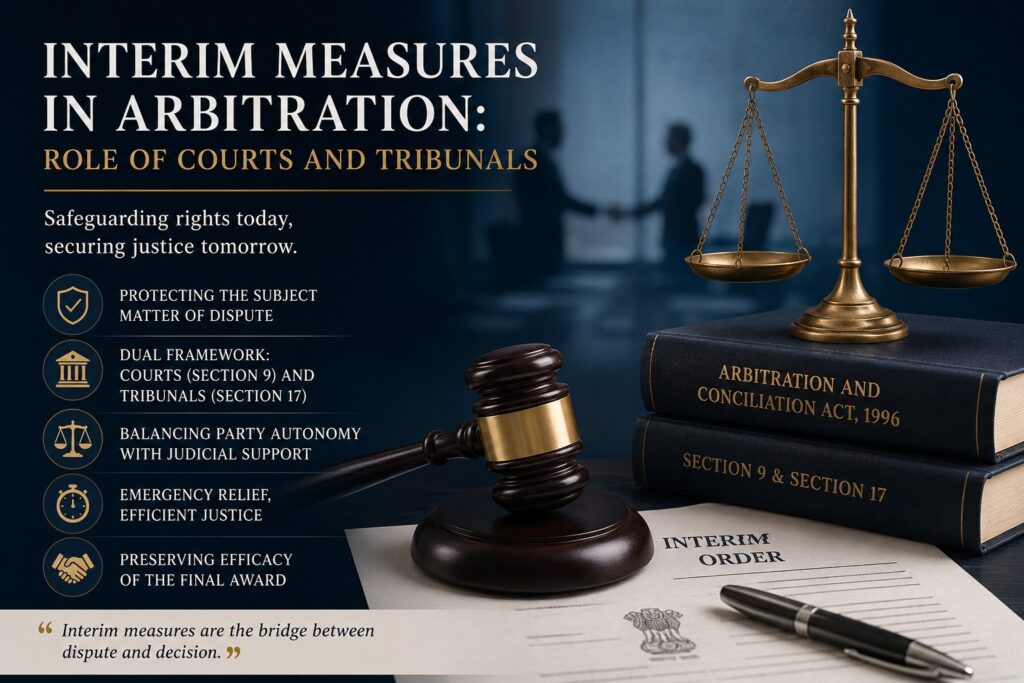
Interim Measures in Arbitration: Role of Courts and Tribunals Introduction Arbitration was conceived as a mechanism to resolve commercial disputes swiftly, privately, and with minimal judicial interference. Yet disputes rarely wait patiently for a tribunal to be constituted. Assets may be dissipated, evidence destroyed, contracts breached irreparably, or a status quo altered — all before an arbitral tribunal even comes into existence. It is this urgent, protective function that interim measures serve. They preserve the subject matter of the dispute, secure the eventual award, and ensure that arbitration does not become an empty victory. The law relating to interim measures in arbitration occupies a unique space at the intersection of party autonomy and judicial oversight. On one hand, arbitration derives its legitimacy from the parties’ agreement to resolve disputes outside the court system. On the other, courts retain — and must retain — certain residual powers to protect the integrity of the arbitral process, particularly at moments when the tribunal cannot yet act. This article examines the evolving framework governing interim relief, the respective competencies of courts and tribunals, and the tensions and complementarities between the two under Indian and international arbitration law. Understanding Interim Measures: Purpose and Scope Interim measures, also called interim reliefs or provisional measures, are temporary orders granted to preserve rights, assets, or evidence pending final adjudication of a dispute. They typically include orders for: Preservation of goods or property forming the subject matter of the dispute Injunctions restraining a party from dealing with assets or taking specific actions Appointment of a receiver Security for costs or for the amount in dispute Interim custody or sale of perishable goods Preservation of evidence The underlying rationale is straightforward: an arbitral award, however sound, is worthless if by the time it is rendered, the assets to satisfy it have vanished or the subject matter of the dispute has been irreversibly altered. Interim measures thus function as a bridge — safeguarding the efficacy of the final award throughout the life of the arbitral proceeding, including the vulnerable period before a tribunal is even constituted. The Statutory Framework in India The Arbitration and Conciliation Act, 1996 (as amended in 2015 and 2019) draws heavily from the UNCITRAL Model Law and provides a dual-track mechanism for interim relief — one through courts under Section 9, and the other through arbitral tribunals under Section 17. Section 9: Court-Ordered Interim Measures Section 9 empowers a party to approach a court for interim measures either before the commencement of arbitral proceedings, during the proceedings, or after the making of the arbitral award but before its enforcement. This provision recognises a critical practical reality: at the pre-arbitral stage, when no tribunal exists, only a court can grant urgent protective relief. Without such a safety valve, a party facing imminent asset dissipation or evidence destruction would have no recourse until the tribunal was formed — by which time the damage may already be done. The 2015 Amendment introduced a significant check on this power through Section 9(3), which provides that once an arbitral tribunal has been constituted, the court shall not entertain an application under Section 9(1) unless it finds that circumstances exist which may render the remedy under Section 17 inefficacious. This amendment was a direct legislative response to the tendency of parties to bypass tribunals and approach courts even after arbitration had commenced, undermining the tribunal’s authority and causing delay. The effect is to make Section 17 the primary route for interim relief once a tribunal is in place, with Section 9 reserved for the pre-arbitral vacuum or genuine cases of inefficacy. Section 17: Tribunal-Ordered Interim Measures Section 17, as substantially strengthened by the 2015 Amendment, empowers arbitral tribunals to grant the same range of interim measures that a court could grant under Section 9. Crucially, the amendment also provided that an order of the tribunal under Section 17 “shall be deemed to be an order of the Court” and shall be enforceable under the Code of Civil Procedure, 1908, in the same manner as a court order. This was a watershed change. Previously, tribunal orders under Section 17 lacked independent enforceability, and a party had to approach a court separately to enforce them — a cumbersome detour that diluted the tribunal’s authority and often nullified the urgency of the relief. By granting Section 17 orders the same enforceability as court orders, the legislature sought to make tribunals genuinely competent and self-sufficient forums for interim protection, thereby reducing unnecessary recourse to courts and reinforcing the principle of minimal judicial intervention that underlies the Act (as expressed in Section 5). Judicial Interpretation: Calibrating the Balance Indian courts have played a significant role in shaping the contours of this dual framework. In Firm Ashok Traders v. Gurumukh Das Saluja (2004), the Supreme Court clarified that an application under Section 9 is maintainable even by a person claiming to be a party to an arbitration agreement, and that such proceedings are independent of the arbitral proceedings themselves, though ancillary to them. The Bombay High Court’s decision in Nimbus Communications Ltd. v. Board of Control for Cricket in India (2012) addressed the extent of a court’s power under Section 9 to grant interim measures in aid of foreign-seated arbitrations, an issue of considerable importance to India’s engagement with international commercial arbitration. Post-2015, courts have generally been cautious about entertaining Section 9 applications once a tribunal is constituted, giving effect to the legislative intent behind Section 9(3). However, courts have also recognised that “inefficacious” is a factual determination — where a tribunal lacks the power to grant relief against a non-signatory third party, for instance, or where the urgency is such that even the short time needed to approach the tribunal would defeat the purpose of the relief, courts have stepped in notwithstanding Section 9(3). The Supreme Court’s decision in Arcelor Mittal Nippon Steel India Ltd. v. Essar Bulk Terminal Ltd. (2021) further clarified that once a Section 17 application is filed and an order passed, a subsequent Section 9 application on the same subject matter is generally not maintainable, reinforcing the primacy of the tribunal once seized of the matter, while also affirming that appellate remedies against Section 17 orders lie under Section 37, not through fresh Section 9 proceedings. Emergency Arbitration: A Hybrid Innovation A significant gap in the statutory scheme concerns the period between the invocation of arbitration and the formal constitution of the tribunal — often several weeks under institutional rules. International arbitral institutions have responded to this gap through emergency arbitrator provisions, which allow parties to obtain urgent interim relief from a specially appointed emergency arbitrator even before the main tribunal is formed. The enforceability of emergency arbitrator orders under Indian law long remained contested, since the 1996 Act does not expressly recognise the concept. The Delhi High Court’s ruling in Amazon.com NV Investment Holdings LLC v. Future Retail Ltd. (2021) was pivotal in this regard, with the Supreme Court affirming that orders passed by an emergency arbitrator under institutional rules (in that case, the SIAC Rules) can be enforced under Section 17(2) of the Act, treating the emergency arbitrator as part of the tribunal machinery contemplated by the statute. This judicial recognition has considerably strengthened the practical utility of emergency arbitration for parties operating under institutional arbitration clauses, though the 2019 Amendment’s proposal to formally recognise emergency arbitration in the statute itself remains, as yet, not fully implemented. Comparative Perspectives The Indian framework mirrors, to a considerable extent, the approach taken under the UNCITRAL Model Law on International Commercial Arbitration, particularly following its 2006 revisions, which introduced a detailed regime for tribunal-ordered interim measures and their cross-border enforcement. Jurisdictions such as Singapore and Hong Kong, both leading arbitration hubs, have similarly empowered courts to act in support of arbitration — including foreign-seated arbitration — while maintaining a policy of restraint once a tribunal has been constituted, reflecting the internationally accepted principle that court intervention should be supportive rather than supervisory. The English Arbitration Act, 1996, likewise permits courts to grant interim relief but generally requires that the tribunal be unable to act effectively, or that urgency justifies bypassing the tribunal — a formulation conceptually similar to India’s “inefficacious” standard. Challenges and the Way Forward Despite the maturation of this framework, certain difficulties persist. First, the enforcement of Section 17 orders, while nominally equated with court orders, can still encounter practical friction, particularly where the order involves complex proprietary or third-party interests. Second, the interim relief regime for foreign-seated arbitrations under Section 9 (applicable via Section 2(2) proviso) continues to generate litigation regarding its precise scope. Third, formal statutory recognition of emergency arbitration — rather than reliance on judicial interpretation alone — would considerably enhance certainty for parties and counsel structuring dispute resolution clauses. Going forward, a calibrated approach that preserves the tribunal’s primacy while retaining courts as a genuine safety net for extraordinary situations appears to be the most coherent path. This requires continued judicial discipline in applying the “inefficacious” threshold under Section 9(3), timely constitution of tribunals to reduce the pre-arbitral vacuum, and legislative clarity on emergency arbitration. Conclusion The interplay between courts and tribunals in granting interim measures reflects arbitration’s broader philosophical balancing act — the desire for party autonomy and finality, tempered by the practical necessity of judicial support at critical junctures. India’s post-2015 framework, reinforced by judicial pronouncements such as Amazon v. Future Retail and Arcelor Mittal, has moved decisively toward strengthening tribunals as the primary forum for interim relief, while preserving courts as a residual safeguard. As India continues to position itself as a arbitration-friendly jurisdiction, the continued refinement of this framework — through both legislative reform and judicial consistency — will be essential to ensuring that interim measures fulfil their core purpose: protecting the object of arbitration without undermining its process. Endnotes Arbitration and Conciliation Act, No. 26 of 1996, §§ 2(2), 5, 9, 17, 34, 37 (India). Code of Civil Procedure, No. 5 of 1908 (India). UNCITRAL, UNCITRAL Model Law on International Commercial Arbitration arts. 17–17J (2006). Convention on the Recognition and Enforcement of Foreign Arbitral Awards, June 10, 1958, 330 U.N.T.S. 3. Firm Ashok Traders v. Gurumukh Das Saluja, (2004) 3 SCC 155. Nimbus Communications Ltd. v. Board of Control for Cricket in India, 2012 SCC OnLine Bom 483. Arcelor Mittal Nippon Steel India Ltd. v. Essar Bulk Terminal Ltd., (2022) 1 SCC 712. Amazon.com NV Investment Holdings LLC v. Future Retail Ltd., (2022) 1 SCC 209. Arbitration Act 1996, c. 23 (U.K.). Singapore International Arbitration Centre, SIAC Rules (7th ed. 2025), sch. 1 (Emergency Arbitrator Procedure). Gary B. Born, International Commercial Arbitration (3d ed. 2021). Avtar Singh, Law of Arbitration and Conciliation (Eastern Book Company, latest ed.).
Offshore Wind Energy in India: Legal Opportunities and Regulatory Challenges

Introduction India’s energy transition has largely been powered by two familiar sources: solar parks stretching across Rajasthan and Gujarat, and onshore wind farms dotting Tamil Nadu and Karnataka. But as land for renewable projects becomes scarcer and more contested, attention is turning seaward. With a coastline of over 7,600 kilometres and estimated offshore wind potential […]