
Seat vs Venue in International Arbitration: The Distinction That Actually Matters (Draft Clauses, Court Tests & Supervisory Jurisdiction Explained)

Introduction International commercial arbitration rests on party autonomy, efficient procedures and predictability of judicial approval. Of the choices that parties make when they write or draft an arbitration agreement, few have more long-term implications than the “seat” of arbitration. However, the terms “seat,” “venue,” and “place” are still used interchangeably in contracts and in so […]
Freedom of Speech during Protests: Protection of Slogans, Placards, Speeches and Symbolic Acts

Introduction: Protest is one of the oldest instruments of democratic dialogue. Long before constitutions codified the “right to free speech,” ordinary people expressed dissent through chants, banners, and defiant gestures in public squares. In the modern constitutional state, this instinct for collective expression has been absorbed into the guarantee of freedom of speech and expression […]
International Construction Arbitration: Delay Claims, Force Majeure, and Allocation of Political Risk.

Introduction It goes without saying that the construction industry is one of the greatest sources of global economic growth. Large-scale infrastructure projects, like highways, airports, power stations, railroads, and other commercial ventures usually include many entities from various countries. Hence, it becomes evident that contracts become very complex. These projects usually require significant financial resources, […]
Women’s Equal Political Participation: CEDAW Standards Compared with Constitutional Guarantees and Legislative Reservation in India
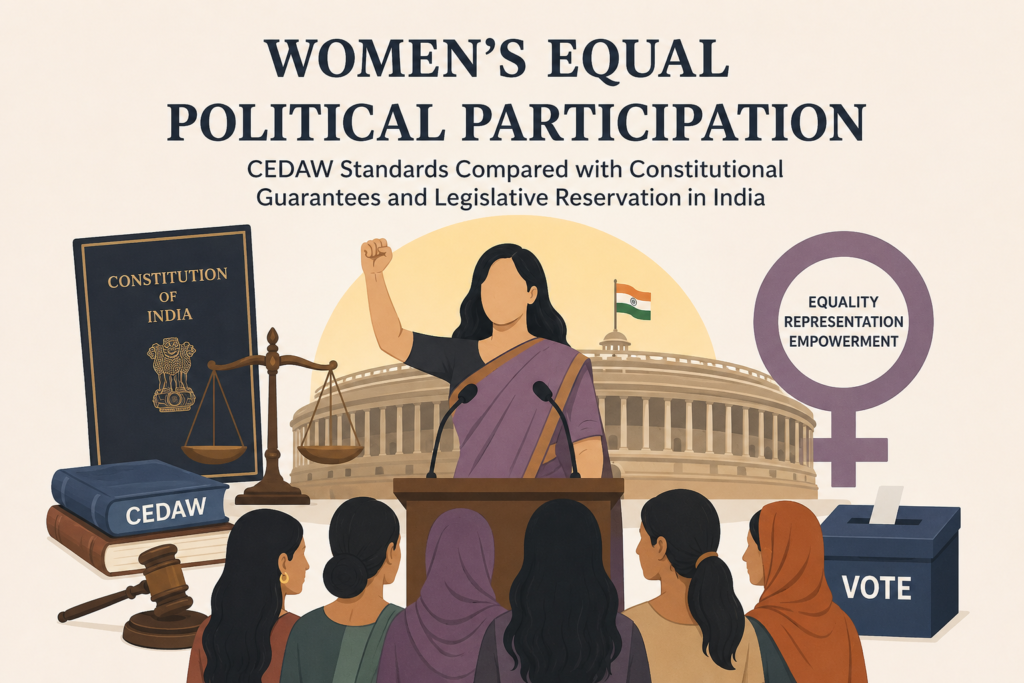
Introduction Political participation is one of the most important indicators of a democratic society. Democracy cannot function effectively when half of its population remains inadequately represented in decision-making institutions. Women constitute nearly half of India’s population, yet their representation in Parliament and State Legislatures has historically remained low. India has made notable progress by reserving […]
Ethical Reporting of Protests: Verification, Context, Graphic Content and the Avoidance of Prejudice in Media Ethics

Ethical Reporting of Protests: Verification, Context, Graphic Content and the Avoidance of Prejudice in Media Ethics A Comprehensive Legal Analysis Author: Garvita Mishra | Law Vaani Editorial Protests are not disruptions to public life in India. They are part of it. From farmers blocking highways to students marching against fee hikes, the right to assemble […]
Pre-Trial Detention and the Right to Liberty under International Human Rights Law: Necessity, Proportionality and Judicial Review

Pre-Trial Detention and the Right to Liberty under International Human Rights Law: Necessity, Proportionality and Judicial Review Introduction Pre-trial detention occupies one of the most contested spaces in criminal justice. It allows the State to deprive an accused person of liberty before guilt has been established by a competent court. While detention may be necessary […]
Equitable and Reasonable Utilisation of Shared Rivers: Resolving Transboundary Water Conflicts under International Law.
Equitable and Reasonable Utilisation of Shared Rivers: Resolving Transboundary Water Conflicts under International Law Abstract Transboundary rivers are vital sources of freshwater, supporting agriculture, industries, ecosystems, and human survival across national borders. As water scarcity, climate change, and increasing developmental demands intensify, disputes over shared rivers have become more frequent. International water law seeks to […]
Who Pulls the Trigger? Autonomous Weapons, Meaningful Human Control, and the Search for Accountability under International Humanitarian Law
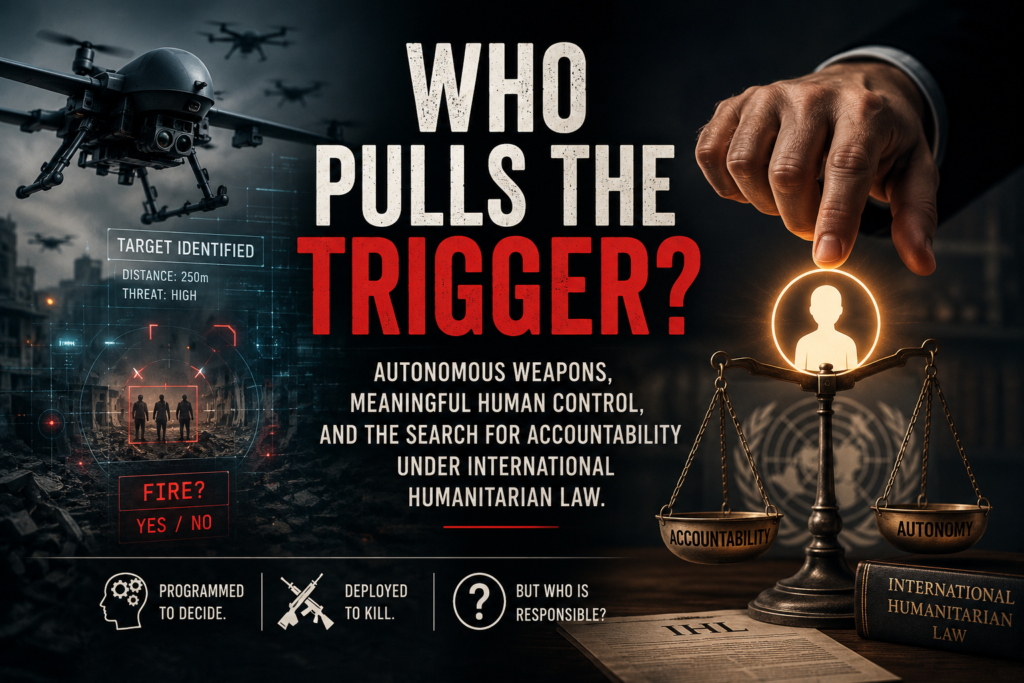
Who Pulls the Trigger? Autonomous Weapons, Meaningful Human Control, and the Search for Accountability under International Humanitarian Law AUTHOR’S NAME: ISHITA BHUSHAN Introduction Warfare has always been ahead of the law, but this tendency to outpace may prove a critical weakness in the case of autonomous systems. The question of whether weaponry should be able […]
The Duty to Prevent Transboundary Air Pollution: International Environmental Obligations and Access to Remedies
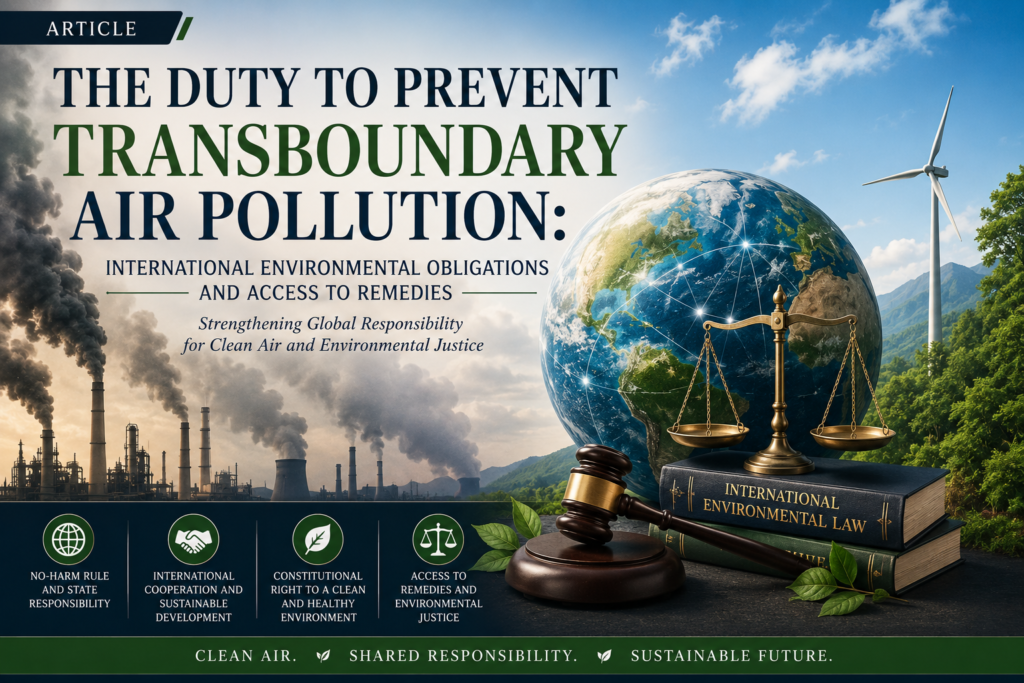
Part I: Abstract Transboundary air pollution is a significant global environmental challenge in which pollutants released in one country travel across national borders, causing adverse effects on public health, ecosystems, biodiversity, and economic activities in neighbouring States. Pollutants such as sulphur dioxide (SO₂), nitrogen oxides (NOₓ), particulate matter (PM2.5 and PM10), ozone, and greenhouse gases […]
Artificial Intelligence and Copyright Law in India: Rethinking Authorship in the Age of Generative AI

Artificial Intelligence and Copyright Law in India: Rethinking Authorship in the Age of Generative AI Abstract Artificial Intelligence (AI) has fundamentally altered the landscape of creativity by enabling machines to generate literary, artistic, musical, and audiovisual works with minimal human intervention. While these technological developments promise unprecedented innovation, they simultaneously expose significant gaps in traditional […]