
Equitable and Reasonable Utilisation of Shared Rivers: Resolving Transboundary Water Conflicts under International Law.

Equitable and Reasonable Utilisation of Shared Rivers: Resolving Transboundary Water Conflicts under International Law Abstract Transboundary rivers are vital sources of freshwater, supporting agriculture, industries, ecosystems, and human survival across national borders. As water scarcity, climate change, and increasing developmental demands intensify, disputes over shared rivers have become more frequent. International water law seeks to […]
Who Pulls the Trigger? Autonomous Weapons, Meaningful Human Control, and the Search for Accountability under International Humanitarian Law
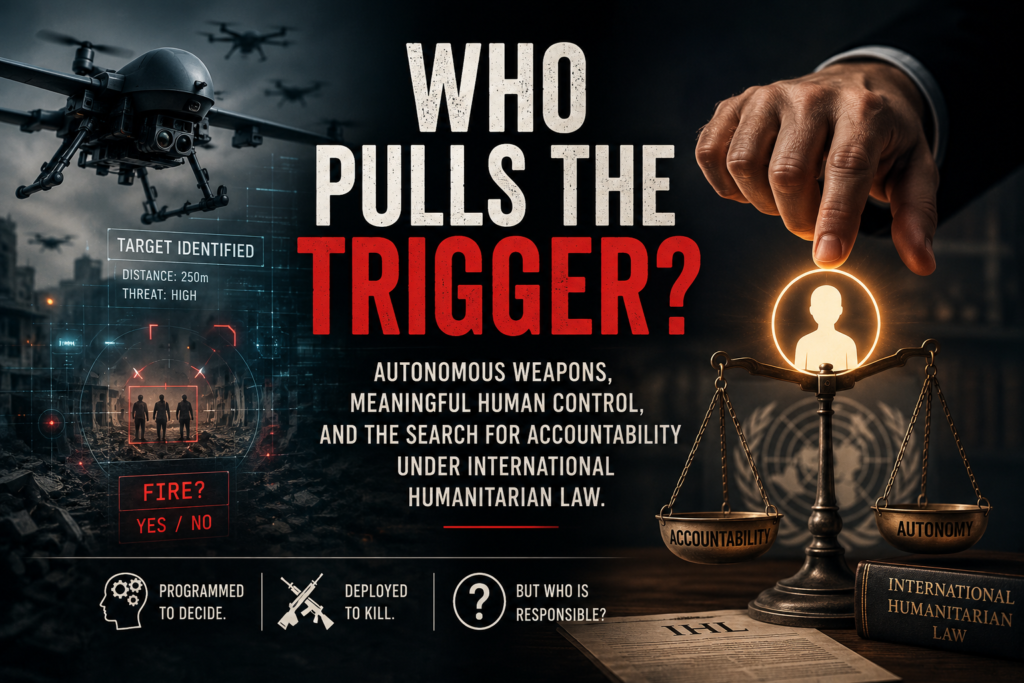
Who Pulls the Trigger? Autonomous Weapons, Meaningful Human Control, and the Search for Accountability under International Humanitarian Law AUTHOR’S NAME: ISHITA BHUSHAN Introduction Warfare has always been ahead of the law, but this tendency to outpace may prove a critical weakness in the case of autonomous systems. The question of whether weaponry should be able […]
The Duty to Prevent Transboundary Air Pollution: International Environmental Obligations and Access to Remedies

Part I: Abstract Transboundary air pollution is a significant global environmental challenge in which pollutants released in one country travel across national borders, causing adverse effects on public health, ecosystems, biodiversity, and economic activities in neighbouring States. Pollutants such as sulphur dioxide (SO₂), nitrogen oxides (NOₓ), particulate matter (PM2.5 and PM10), ozone, and greenhouse gases […]
Artificial Intelligence and Copyright Law in India: Rethinking Authorship in the Age of Generative AI

Artificial Intelligence and Copyright Law in India: Rethinking Authorship in the Age of Generative AI Abstract Artificial Intelligence (AI) has fundamentally altered the landscape of creativity by enabling machines to generate literary, artistic, musical, and audiovisual works with minimal human intervention. While these technological developments promise unprecedented innovation, they simultaneously expose significant gaps in traditional […]
Protection of Cultural Property During Armed Conflict: Enforcement Challenges Under the 1954 Hague Convention

Abstract Wars destroy a lot of things. Homes, roads, hospitals, and sadly, human lives too. But there is another kind of loss that people don’t always talk about — the loss of history itself. Old temples, museums, libraries, ancient manuscripts, statues, and monuments have been bombed, looted, or burned down during many wars. Once these […]
Restrictive State Immunity in International Law and India: A Comparative Study of Global Practice and Section 86 of the Code of Civil Procedure
Introduction The doctrine of state immunity occupies a central position in public international law by defining the extent to which one sovereign State may exercise judicial authority over another. It is founded upon the principle of sovereign equality, in the Latin maxim “par in parem non habet imperium”, meaning that an equal has no authority […]
Human Rights Beyond the Law: Bridging the Gap Between Constitutional Guarantees and Ground Realities

Human Rights Beyond the Law: Bridging the Gap Between Constitutional Guarantees and Ground Realities A Critical Analysis of the Disconnect Between Legal Rights and Lived Realities in Contemporary India Abstract Human rights are often celebrated as the foundation of justice, equality, and human dignity. Constitutions, international treaties, and national legislations promise every individual the right […]
Diplomatic Protection of Nationals Abroad: Conditions, Limitations, and Contemporary State Practice
Diplomatic Protection of Nationals Abroad: Conditions, Limitations, and Contemporary State Practice Abstract Diplomatic protection remains a cornerstone mechanism of state responsibility under customary international law, enabling a sovereign state to invoke the responsibility of another state for injuries inflicted upon its natural or legal persons abroad. Historically conceived as an exclusive sovereign prerogative anchored in […]
Step-by-Step Guide to Filing a Private Criminal Complaint under BNSS for Forgery of Valuable Security

Counterfeiting of Currency and Securities across Borders: International Cooperation in Investigation, Extradition and Prosecution Navigating Global Challenges in Financial Crime Enforcement By Shashi Ranjan LLB 2nd Year Student, University of Allahabad Intern, Adv. Omkar Pardeshi and Associates Abstract Counterfeiting of currency and securities has become one of the most damaging forms of transnational crime in the modern world. Sophisticated fake notes and forged financial instruments not only drain government revenues and shake public confidence in money but also bankroll larger criminal enterprises like terrorism financing and drug cartels. This article takes a close look at how countries work together to investigate, extradite, and prosecute these offenders. It draws on the landmark 1929 Geneva Convention, the UN conventions against organized crime and corruption, and the practical work of INTERPOL and securities regulators. Through real cases and a critical lens, it points out what is working, what still falls short, and what practical steps can make cooperation more effective. In the end, beating this threat requires more than treaties on paper; it demands genuine trust, better tools, and a shared commitment across borders. Introduction When I first started researching this topic for my internship, I was struck by how ordinary it seems on the surface, fake notes changing hands, yet how deeply it damages economies and societies. In a globalized world, a printing press in one country can flood markets thousands of miles away, while forged securities quietly undermine stock exchanges and investor trust. For India, with its growing role in international finance, these crimes are not distant problems. They affect everything from the RBI’s efforts to maintain currency integrity to SEBI’s oversight of capital markets. This article tries to make sense of the international response. It examines the legal foundations, how investigations and extraditions actually play out in practice, and where the system still struggles. My hope is to offer a clear-eyed assessment that goes beyond textbook summaries and points toward real improvements. The stakes are high: without stronger cooperation, criminals will continue to exploit the gaps between national laws. Background and Legal Framework The story of international action against currency counterfeiting really begins in the unstable years after the First World War. Countries realized that fake money was no longer just a domestic headache but a threat that crossed borders easily. This led to the International Convention for the Suppression of Counterfeiting Currency, signed in Geneva in 1929. The treaty is straightforward but powerful. It requires states to make it a serious crime to manufacture, alter, or knowingly circulate fake currency, whether local or foreign. It calls for central offices in each country to share information, specimens of genuine and fake notes, and details about known forgers. Most importantly, it makes these offenses extraditable. This convention helped give birth to what we now know as INTERPOL, creating a network for police forces to collaborate directly. National central offices still serve as the day-to-day contact points, working with central banks to track new threats. When it comes to securities like bonds or share certificates, the rules are spread across wider treaties. The United Nations Convention against Transnational Organized Crime (UNTOC, 2000) and the United Nations Convention against Corruption (UNCAC, 2003) are especially useful. They cover situations where counterfeiting is part of larger criminal organizations and emphasize mutual legal assistance, joint investigations, and getting stolen money back. Regulators also talk to each other through IOSCO’s multilateral arrangements, which help share evidence when fake securities cross markets. In India, laws like the Prevention of Money Laundering Act, the Extradition Act, and RBI/SEBI guidelines help us plug into this global system. The framework looks solid, but as we will see, turning these promises into consistent action is the real challenge. Main Analysis and Case Studies Day-to-day investigation depends heavily on information sharing. INTERPOL maintains specialized databases and issues alerts when new high-quality fakes appear. Its secure communication system lets officers in different countries coordinate quickly, tracing shipments, freezing accounts, and planning raids together. Large-scale operations have shown what is possible when agencies pool resources. Extradition is where things get more complicated but also more visible. The 1929 Convention built in rules that treat counterfeiting as an ordinary serious crime, making it easier to bring people back to face justice. Real cases bring these rules to life. In one recent example, Germany extradited two men, one Azerbaijani and one Georgian, to Ukraine after they ran a scheme smuggling counterfeit US dollars through conflict zones and selling them online. Ukrainian authorities had solid evidence from their investigation, and Germany acted on the request. Another striking case involved a Lebanese man wanted in the United States for distributing large amounts of convincing fake dollars and euros. He was arrested in Malaysia and eventually sent to the US after undercover operations showed the scale of the network. On the securities side, American regulators have used international cooperation to go after cross-border fraud rings involving fake company documents and market manipulation. These efforts often combine police work with regulatory requests for bank records and witness statements. In the Indian setting, we have seen PMLA cases where foreign evidence and asset tracing have helped build strong prosecutions, though the process can sometimes feel slow. These examples show that when countries share evidence promptly and trust each other’s systems, convictions and recoveries do happen. Prosecution then turns that evidence into courtroom proof. Mutual legal assistance lets prosecutors obtain certified documents, expert opinions on whether notes are fake, and even remote testimony. Asset recovery provisions help return money to victims or governments. The best results come when teams from different countries work in parallel rather than waiting for one another. Critical Analysis and Evaluation For all its strengths, the current system has noticeable weaknesses. Dual criminality, the rule that the act must be a crime in both countries, still blocks some requests, especially when one nation treats economic offenses less seriously. Some countries are slow to extradite their own nationals or drag out proceedings with appeals, giving suspects time to hide assets. Resource differences matter enormously. Wealthier nations have better labs and faster response teams, while many others struggle to keep up with INTERPOL’s technical standards. In India we have made progress with the RBI’s security features and training, but scaling forensic capacity and digital monitoring remains an ongoing task. New technologies are changing the game faster than the law can adapt. Criminals now use better printers, sell components online, and launder proceeds through cryptocurrencies. The 1929 Convention could not have foreseen these developments, and many treaties still feel dated when applied to digital forgery or manipulated electronic securities. There is also an imbalance in practice. Powerful jurisdictions tend to get quicker cooperation when they ask for help than when smaller countries make requests. Political or diplomatic considerations sometimes creep in, even though everyone agrees these should be purely law enforcement matters. Indian courts have generally taken a balanced approach, insisting on basic fairness and sufficient evidence before ordering extradition. That caution is important, but it can contribute to delays. To fix these problems, countries should consider faster emergency MLA channels for counterfeiting cases, shared forensic training programs, and perhaps a modern protocol that updates the 1929 rules for securities and online threats. India is well-placed to push for stronger cooperation within regional groups like SAARC or BRICS. Regular reviews similar to FATF evaluations could also keep pressure on everyone to improve. Conclusion Looking back at the history and the cases, it is clear that international cooperation has come a long way since the 1929 Convention. We have the tools, treaties, police networks, and regulatory channels, but using them consistently and creatively is still a work in progress. Criminals do not respect borders; our response cannot afford to be slowed by outdated procedures or unequal capacities. For students like me and for practitioners in India, the lesson is straightforward: strong domestic laws and institutions are essential, but they must be paired with active engagement in global forums. By investing in better technology, training, and personal relationships between agencies, we can make cooperation faster and fairer. In the end, protecting the integrity of money and markets is not just a legal duty, it is fundamental to economic stability and public trust. The international community has the foundation; now it needs the will and the imagination to build on it. References & Citations InternationalConvention for the Suppression of Counterfeiting Currency, 1929 — Official text and parties: https://en.wikipedia.org/wiki/International_Convention_for_the_Suppression_of_Counterfeiting_Currency UNTOC(2000) and UNCAC (2003) — UNODC pages: https://www.unodc.org/corruption/en/learn/what-is-uncac/international-cooperation.html INTERPOLCounterfeit Currency: https://www.interpol.int/Crimes/Counterfeit-currency-and-security-documents/Counterfeit-currency 2025Ukraine Extradition: https://news.liga.net/en/politics/news/suspects-in-the-sale-of-counterfeit-dollars-in-ukraine-extradited-from-germany LebaneseNational Case — US DOJ: https://www.justice.gov/archives/opa/pr/lebanese-national-extradited-malaysia-face-charges-wide-ranging-counterfeit-currency-plot SECCross-Border Efforts: https://www.sec.gov/newsroom/press-releases/2025-113-sec-announces-formation-cross-border-task-force-combat-fraud INTERPOLOperations: https://www.gherson.com/blog/interpol-fraud-investigations-operation-first-light-2026/
Foreign Investment in Real Estate and Housing Rights: Regulating Speculation Without Breaching International Economic Obligations

Foreign Investment in Real Estate and Housing Rights: Regulating Speculation Without Breaching International Economic Obligations Author – Tamanna Verma Introduction The increasing global movement of capital has transformed real estate from a largely domestic asset into an international investment opportunity. Foreign investment in the real estate sector has contributed to economic growth by bringing […]