
Women Reservation Bill: A Transformative Step towards Gender Equality in Indian Politics

Women Reservation Bill: A Transformative Step towards Gender Equality in Indian Politics The equality of women in political decision making is an essential element of a democratic country[1]. A democracy can flourish when all sections of society receive equal representation through representation and opportunity[2]. In India, although nearly half the population is female, for decades […]
Custodial Harassment: How to Legally Report and Prove Mental or Physical Abuse by Investigating Officers (Accused & Police Rights)

Introduction Investigating crimes is arguably one of the greatest responsibilities conferred on the police force. Effective investigations are vital for the maintenance of public order, protection of the victims, and apprehension of those guilty of committing the offenses. This power, however, is neither unlimited nor unrestricted. In a constitutional democracy where the rule of law […]
Arrest Rules for Women: What Are Your Rights When Police Seek to Question or Detain a Female Citizen?
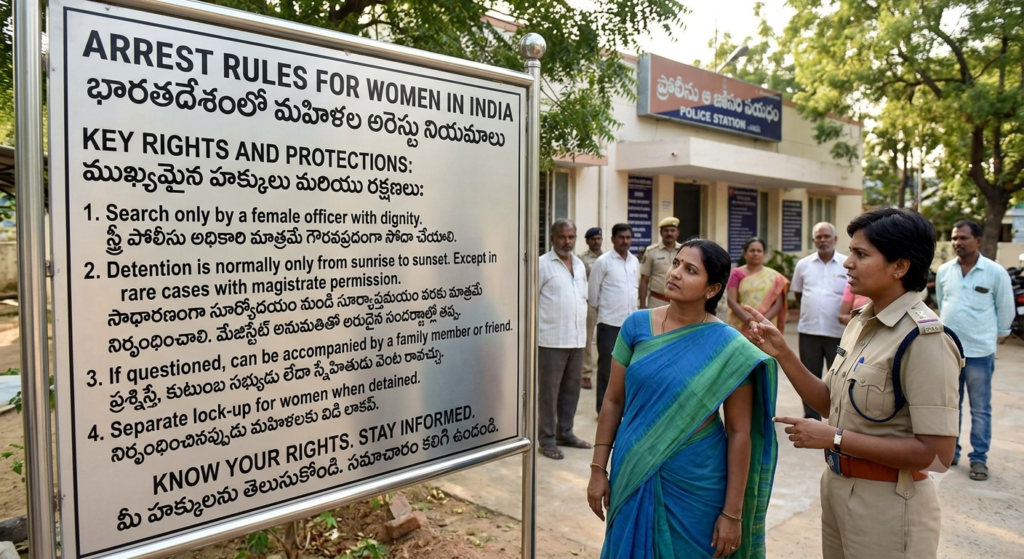
Introduction In India, the power to arrest is among the most intrusive interventions that the State exercises over the individual. It suspends liberty, separates a person from family and workplace, and exposes them to the coercive environment of a police station. The law has always sought to regulate this power, but its exercise has historically […]
Deepfakes & AI Impersonation: Legal Recourse and Rights for Victims of Synthetically Altered Videos
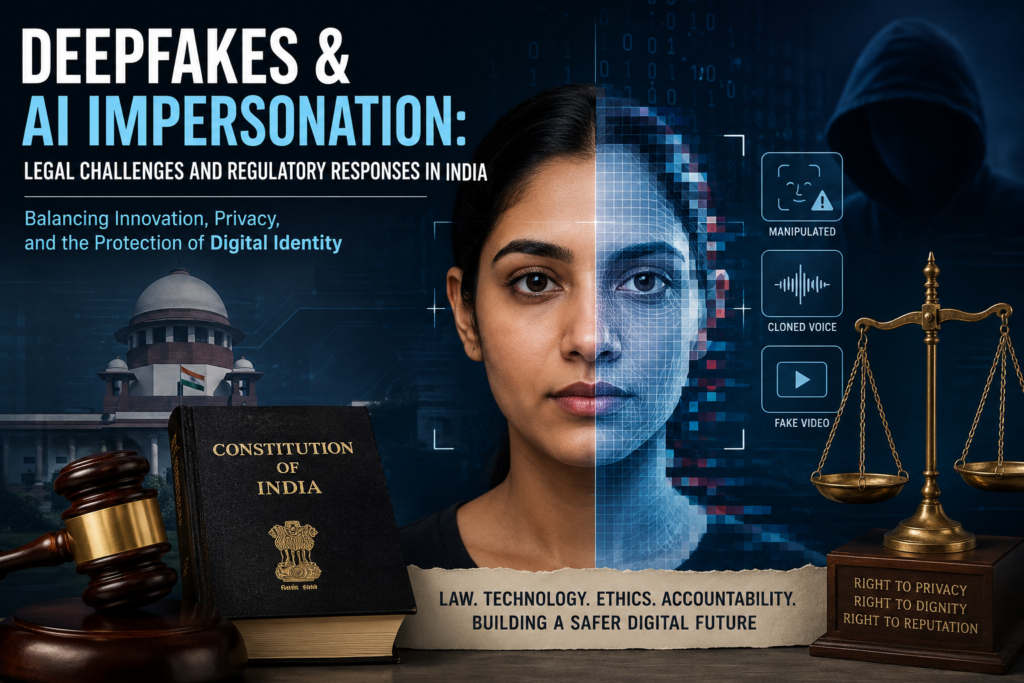
Deepfakes & AI Impersonation: Legal Recourse and Rights for Victims of Synthetically Altered Videos Examining India’s Constitutional Safeguards, Criminal Remedies, and Emerging Legal Framework Against AI-Generated Digital Manipulation Author: Krushna Bawa, Student at DES’s Shri Navalmal Firodia Law College, Pune Abstract: Artificial Intelligence (AI) refers to technology allowing computers and machines to mimic human capabilities […]
Step-by-Step Guide to Filing a Private Criminal Complaint under BNSS for Forgery of Valuable Security
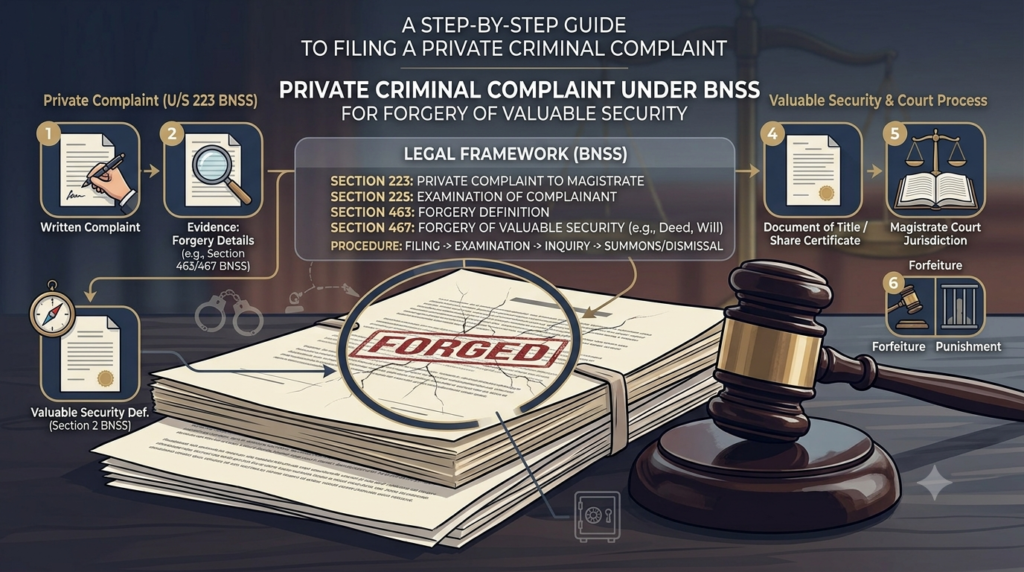
Step-by Step Guide to Filing a Private Criminal Complaint under BNSS for Forgery of Valuable Security Shashi Ranjan LL.B. (2nd Year), University of Allahabad Intern, Adv. Omkar Awasthi and Associates Keywords: Private Complaint under BNSS, Section 223 BNSS, Forgery of Valuable Security, Pre-Cognizance Hearing, BNS Section 338 Abstract / Introduction The criminal justice system in India witnessed a major overhaul with the introduction of the Bharatiya Nagarik Suraksha Sanhita, 2023 (BNSS), which replaced the old CrPC and became effective from 1 July 2024. The new law aims to make procedures more citizen-friendly, time-bound, and balanced. Among its notable changes is Section 223 BNSS, which deals with the examination of the complainant in private complaint cases. While it carries forward the essence of the old Section 200 CrPC, it adds an important layer of protection by requiring the Magistrate to give the accused an opportunity to be heard before taking cognizance. Forgery of valuable security, now punishable under Section 338 of the Bharatiya Nyaya Sanhita, 2023 (BNS) (earlier Section 467 IPC), is a grave offence. It involves creating or altering a document that appears to be a valuable security, will, or any instrument that grants authority over money, property, or rights. The punishment can extend to life imprisonment or up to ten years, plus fine. Such crimes not only inflict financial harm but also shake trust in important legal and financial documents like promissory notes, bonds, share certificates, and property deeds. In my experience during the internship, victims of forgery—particularly in property or business dealings—often struggle to get the police to register an FIR, as officers sometimes dismiss the matter as civil. The Supreme Court has consistently held that the availability of a civil remedy does not bar criminal proceedings when ingredients of cheating and forgery are made out, as reaffirmed in Punit Beriwala v. State (NCT of Delhi) [2025 INSC 504]. When police assistance is not forthcoming, filing a private complaint before the Magistrate becomes the practical route. This article provides a clear, step-by-step practical guide to filing such a complaint under Section 223 BNSS. It covers the legal framework, important judicial decisions (including recent developments up to mid-2026), ground-level challenges, and possible improvements. Written from the perspective of a second-year law student learning through actual chamber work, the piece tries to blend statutory understanding with real-world application rather than repeating textbook provisions. Background / Legal Framework The BNSS emphasises “Nagarik Suraksha” — protection of citizens. Chapter XVI (Sections 223 to 226) specifically regulates complaints to Magistrates. Under Section 223(1) BNSS, a Magistrate with jurisdiction must examine the complainant and any present witnesses on oath when dealing with a private complaint. The substance of this examination has to be recorded in writing and signed by all concerned. The first proviso is crucial: no cognizance can be taken without affording the accused an opportunity of being heard. Complaints by public servants or courts are exempt from certain requirements. This marks a clear departure from the CrPC era, where the accused had no role until process was issued. The change aims to prevent frivolous or motivated complaints, especially in commercial and property disputes. The offence itself is defined under BNS Section 338. “Valuable security” has a wide meaning and covers documents creating, transferring, or extinguishing legal rights. Complaints frequently combine this with cheating (BNS 318), forgery for cheating (BNS 336), and using forged documents (BNS 340). Jurisdiction lies with the Magistrate where the offence occurred or where the accused resides or works. The complaint must show a prima facie case and should not appear vexatious. Overall, the framework tries to strike a balance between the victim’s right to justice and the accused’s right to fairness. Main Analysis & Case Studies: Step-by-Step Guide Step 1: Thorough Preparation and Drafting Collect strong evidence first — original documents, forged ones, forensic/handwriting expert reports, witness statements, emails, bank records, and proof of loss. Draft the complaint carefully. It should contain: Completedetails of complainant and accused. Chronologicalfacts with dates and events. Specificsections violated (primarily BNS 338 and connected provisions). Listof relied-upon documents and witnesses. Clearprayer seeking examination under Section 223 BNSS, cognizance, and issuance of process. Attach a verifying affidavit. Keep the language factual, precise, and free from hyperbole, because the accused will now get an early chance to respond. Step 2: Filing the Complaint Present the complaint in the concerned Magistrate’s court, preferably in person or through counsel. Follow local rules on copies, fees, and annexures. Step 3: Examination of Complainant and Witnesses (Section 223(1)) The Magistrate will schedule the recording of statements on oath. Prepare thoroughly so that answers remain consistent. This statement forms part of the record and must disclose sufficient grounds. In Basanagouda R. Patil (Yatnal) v. Shivananda S. Patil [2024 SCC OnLine Kar 96], the Karnataka High Court clarified that the Magistrate must first record the complainant’s and witnesses’ statements before issuing notice to the accused. Step 4: Issuance of Notice to the Accused and Pre-Cognizance Hearing After recording statements, the Magistrate issues notice to the accused along with copies of the complaint and statements. The accused can file a reply, submit documents, or make submissions. Several High Courts have reinforced this requirement. The Kerala High Court in Suby Antony v. Respondent No. 1 [2025:KER:6236] and the Allahabad High Court (Lucknow Bench) in Prateek Agarwal v. State of U.P. (13 February 2025) followed the Karnataka view. The Supreme Court has applied the safeguard even to complaints under special laws like PMLA in Kushal Kumar Agarwal v. Directorate of Enforcement [2025 SCC OnLine SC 1221] and Parvinder Singh v. Directorate of Enforcement [2026 INSC 519]. The exact timing remains under consideration. The Delhi High Court in Dr. Rita Bakshi v. Seema Bajaj (18 March 2026) referred the issue to a Larger Bench. Practitioners should monitor this development. Step 5: Magistrate’s Order on Cognizance After hearing both sides, the Magistrate may take cognizance and issue process (Section 227), postpone process for further inquiry (Section 225), or dismiss the complaint (Section 226). The Madhya Pradesh High Court in Vinay Pratap Singh v. Pushpendra Singh (2026) clarified that the hearing does not require full disclosure of all evidence. Step 6: Post-Cognizance Stage If process is issued, the case proceeds as a warrant or summons case (often warrant, given the punishment). Standard trial procedures under BNSS follow. Illustrative Case Studies Forgery cases involving fake deeds or securities require clear proof of dishonest intent and harm. In Kaberi Dey v. Sourav Bhattacharjee [2025 SCC OnLine Cal 5928], the Calcutta High Court cautioned against turning the pre-cognizance hearing into a mini-trial. The Supreme Court’s observations in Punit Beriwala help counter the common defence that the dispute is purely civil. […]
HOW TO FILE A PETITION FOR MAINTENANCE UNDER BNSS:
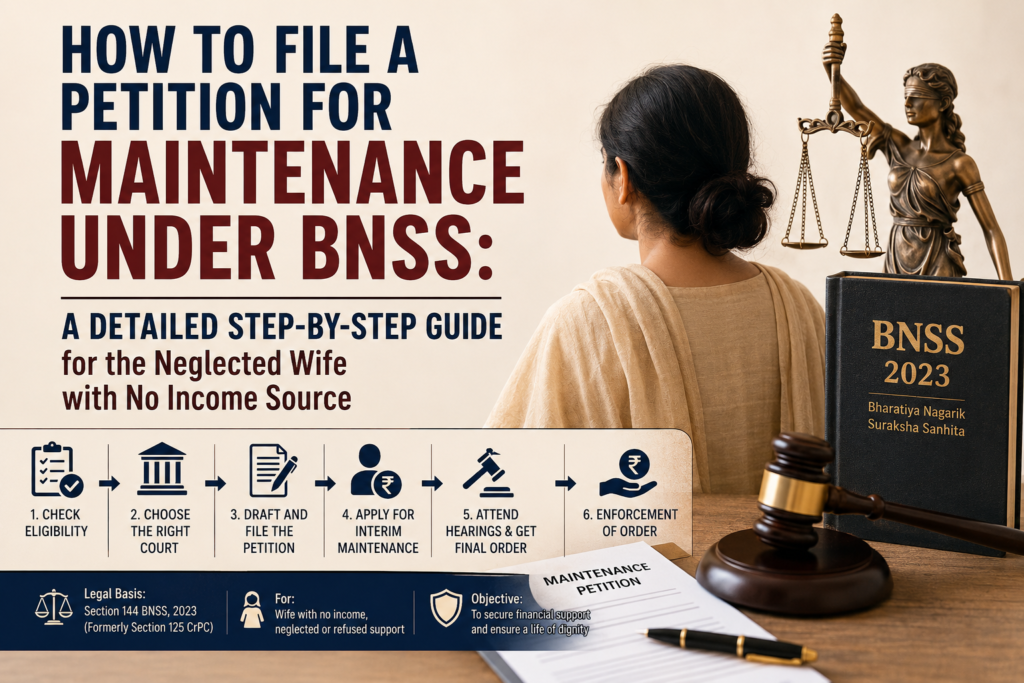
HOW TO FILE A PETITION FOR MAINTENANCE UNDER BNSS: A Detailed Step-by-Step Guide for the Neglected Wife with No Income Source Procedure, Precedent and Policy under Section 144 of the Bharatiya Nagarik Suraksha Sanhita, 2023 Spoorthi B B.A. LL.B. (Hons.), University Law College & Department of Studies in Law, Bangalore University Part I — Abstract […]
Private Criminal Complaint Under the BNSS, 2023: Procedure for Assault or Criminal Force Cases
Private Criminal Complaint Under the BNSS, 2023: Procedure for Assault or Criminal Force Cases: Abstract: What legal remedies are available if a police officer refuses to register your complaint? What legal rights are available to a person whose grievance remains unaddressed? These are some common questions which may arise in the mind of an […]
Beyond the Blue Ticks: Why the Supreme Court Prohibited Police Notices via WhatsApp?

Although there can be many ways to achieve efficiency in the application of law by means of technology, there should not be any compromises in procedural fairness while doing so. In an important direction which protects individual freedom, the Supreme Court of India held that the police cannot issue any pre-arrest appearance notice or witness […]
How to File a Petition for Maintenance under BNSS: A Step-by Step Guide for Minor Child Maintenance
How to File a Petition for Maintenance underBNSS: A Step-by Step Guide for Minor Child Maintenance Abstract This article provides an analytical evaluation of the transition from Section 125 of the Code of Criminal Procedure (CrPC), 1973, to Section 144 of the Bharatiya Nagarik Suraksha Sanhita (BNSS), 2023, specifically focusing on the statutory mechanism for […]
How to File a Complaint for Criminal Defamation under BNS and BNSS: Detailed Legal Process on Social Media Character Assassination
GOVERNING LAW & RELEVANT SECTIONS Primary Offence: Section 356 of BNS, 2023 (formerly Sections 499/500, IPC) — Criminal Defamation Who May Complain: Section 222, Bharatiya Nagarik Suraksha Sanhita (BNSS), 2023 Complaint Procedure: Sections 223–226, Bharatiya Nagarik Suraksha Sanhita (BNSS), 2023 Digital/Social Media Overlay: Sections 66A, 69A, 79, Information Technology Act, 2000 Evidentiary Requirement: Section 63, […]