


-
Shashi Ranjan
Posts

Viral Cases and Invisible Victims: Can Media Attention Distort Which Cases Receive Institutional Priority?
Viral Cases and Invisible Victims: Can Media Attention Distort Which Cases Receive Institutional Priority? By Shashi Ranjan LLB 2nd Year Student, University of Allahabad Intern,...

Visitation Rights After Separation: Schedules, Supervised Meetings and Video Contact
Visitation Rights After Separation: Schedules, Supervised Meetings and Video Contact By Shashi Ranjan LLB 2nd Year Student, University of Allahabad Intern, Adv. Omkar Pardeshi and...
Step-by-Step Guide to Filing a Private Criminal Complaint under BNSS for Forgery of Valuable Security
Counterfeiting of Currency and Securities across Borders: International Cooperation in Investigation, Extradition and Prosecution Navigating Global Challenges in Financial Crime Enforcement By Shashi Ranjan LLB 2nd Year Student, University of Allahabad Intern, Adv. Omkar Pardeshi and Associates Abstract Counterfeiting of currency and securities has become one of the most damaging forms of transnational crime in the modern world. Sophisticated fake notes and forged financial instruments not only drain government revenues and shake public confidence in money but also bankroll larger criminal enterprises like terrorism financing and drug cartels. This article takes a close look at how countries work together to investigate, extradite, and prosecute these offenders. It draws on the landmark 1929 Geneva Convention, the UN conventions against organized crime and corruption, and the practical work of INTERPOL and securities regulators. Through real cases and a critical lens, it points out what is working, what still falls short, and what practical steps can make cooperation more effective. In the end, beating this threat requires more than treaties on paper; it demands genuine trust, better tools, and a shared commitment across borders. Introduction When I first started researching this topic for my internship, I was struck by how ordinary it seems on the surface, fake notes changing hands, yet how deeply it damages economies and societies. In a globalized world, a printing press in one country can flood markets thousands of miles away, while forged securities quietly undermine stock exchanges and investor trust. For India, with its growing role in international finance, these crimes are not distant problems. They affect everything from the RBI’s efforts to maintain currency integrity to SEBI’s oversight of capital markets. This article tries to make sense of the international response. It examines the legal foundations, how investigations and extraditions actually play out in practice, and where the system still struggles. My hope is to offer a clear-eyed assessment that goes beyond textbook summaries and points toward real improvements. The stakes are high: without stronger cooperation, criminals will continue to exploit the gaps between national laws. Background and Legal Framework The story of international action against currency counterfeiting really begins in the unstable years after the First World War. Countries realized that fake money was no longer just a domestic headache but a threat that crossed borders easily. This led to the International Convention for the Suppression of Counterfeiting Currency, signed in Geneva in 1929. The treaty is straightforward but powerful. It requires states to make it a serious crime to manufacture, alter, or knowingly circulate fake currency, whether local or foreign. It calls for central offices in each country to share information, specimens of genuine and fake notes, and details about known forgers. Most importantly, it makes these offenses extraditable. This convention helped give birth to what we now know as INTERPOL, creating a network for police forces to collaborate directly. National central offices still serve as the day-to-day contact points, working with central banks to track new threats. When it comes to securities like bonds or share certificates, the rules are spread across wider treaties. The United Nations Convention against Transnational Organized Crime (UNTOC, 2000) and the United Nations Convention against Corruption (UNCAC, 2003) are especially useful. They cover situations where counterfeiting is part of larger criminal organizations and emphasize mutual legal assistance, joint investigations, and getting stolen money back. Regulators also talk to each other through IOSCO’s multilateral arrangements, which help share evidence when fake securities cross markets. In India, laws like the Prevention of Money Laundering Act, the Extradition Act, and RBI/SEBI guidelines help us plug into this global system. The framework looks solid, but as we will see, turning these promises into consistent action is the real challenge. Main Analysis and Case Studies Day-to-day investigation depends heavily on information sharing. INTERPOL maintains specialized databases and issues alerts when new high-quality fakes appear. Its secure communication system lets officers in different countries coordinate quickly, tracing shipments, freezing accounts, and planning raids together. Large-scale operations have shown what is possible when agencies pool resources. Extradition is where things get more complicated but also more visible. The 1929 Convention built in rules that treat counterfeiting as an ordinary serious crime, making it easier to bring people back to face justice. Real cases bring these rules to life. In one recent example, Germany extradited two men, one Azerbaijani and one Georgian, to Ukraine after they ran a scheme smuggling counterfeit US dollars through conflict zones and selling them online. Ukrainian authorities had solid evidence from their investigation, and Germany acted on the request. Another striking case involved a Lebanese man wanted in the United States for distributing large amounts of convincing fake dollars and euros. He was arrested in Malaysia and eventually sent to the US after undercover operations showed the scale of the network. On the securities side, American regulators have used international cooperation to go after cross-border fraud rings involving fake company documents and market manipulation. These efforts often combine police work with regulatory requests for bank records and witness statements. In the Indian setting, we have seen PMLA cases where foreign evidence and asset tracing have helped build strong prosecutions, though the process can sometimes feel slow. These examples show that when countries share evidence promptly and trust each other’s systems, convictions and recoveries do happen. Prosecution then turns that evidence into courtroom proof. Mutual legal assistance lets prosecutors obtain certified documents, expert opinions on whether notes are fake, and even remote testimony. Asset recovery provisions help return money to victims or governments. The best results come when teams from different countries work in parallel rather than waiting for one another. Critical Analysis and Evaluation For all its strengths, the current system has noticeable weaknesses. Dual criminality, the rule that the act must be a crime in both countries, still blocks some requests, especially when one nation treats economic offenses less seriously. Some countries are slow to extradite their own nationals or drag out proceedings with appeals, giving suspects time to hide assets. Resource differences matter enormously. Wealthier nations have better labs and faster response teams, while many others struggle to keep up with INTERPOL’s technical standards. In India we have made progress with the RBI’s security features and training, but scaling forensic capacity and digital monitoring remains an ongoing task....
Step-by-Step Guide to Filing a Private Criminal Complaint under BNSS for Forgery of Valuable Security
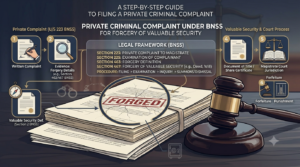
Step-by Step Guide to Filing a Private Criminal Complaint under BNSS for Forgery of Valuable Security Shashi Ranjan LL.B. (2nd Year), University of Allahabad Intern, Adv. Omkar Awasthi and Associates Keywords: Private Complaint under BNSS, Section 223 BNSS, Forgery of Valuable Security, Pre-Cognizance Hearing, BNS Section 338 Abstract / Introduction The criminal justice system in India witnessed a major overhaul with the introduction of the Bharatiya Nagarik Suraksha Sanhita, 2023 (BNSS), which replaced the old CrPC and became effective from 1 July 2024. The new law aims to make procedures more citizen-friendly, time-bound, and balanced. Among its notable changes is Section 223 BNSS, which deals with the examination of the complainant in private complaint cases. While it carries forward the essence of the old Section 200 CrPC, it adds an important layer of protection by requiring the Magistrate to give the accused an opportunity to be heard before taking cognizance. Forgery of valuable security, now punishable under Section 338 of the Bharatiya Nyaya Sanhita, 2023 (BNS) (earlier Section 467 IPC), is a grave offence. It involves creating or altering a document that appears to be a valuable security, will, or any instrument that grants authority over money, property, or rights. The punishment can extend to life imprisonment or up to ten years, plus fine. Such crimes not only inflict financial harm but also shake trust in important legal and financial documents like promissory notes, bonds, share certificates, and property deeds. In my experience during the internship, victims of forgery—particularly in property or business dealings—often struggle to get the police to register an FIR, as officers sometimes dismiss the matter as civil. The Supreme Court has consistently held that the availability of a civil remedy does not bar criminal proceedings when ingredients of cheating and forgery are made out, as reaffirmed in Punit Beriwala v. State (NCT of Delhi) [2025 INSC 504]. When police assistance is not forthcoming, filing a private complaint before the Magistrate becomes the practical route. This article provides a clear, step-by-step practical guide to filing such a complaint under Section 223 BNSS. It covers the legal framework, important judicial decisions (including recent developments up to mid-2026), ground-level challenges, and possible improvements. Written from the perspective of a second-year law student learning through actual chamber work, the piece tries to blend statutory understanding with real-world application rather than repeating textbook provisions....