


-
Bhoomika Sharma
Posts
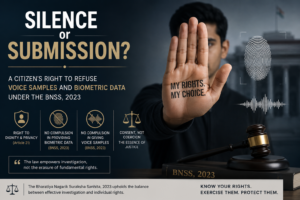
SILENCE OR SUBMISSION? A Citizen’s Right to Refuse Voice Samples and Biometric Data Under the BNSS, 2023
SILENCE OR SUBMISSION? A Citizen’s Right to Refuse Voice Samples and Biometric Data Under the BNSS, 2023 INTRODUCTION The question of whether a citizen can rightfully refuse to give biometric data or voice samples to law enforcement touches on the fundamental constitutional relationship between the individual and the State in India. The tension between the investigative requirements of law enforcement and the fundamental rights of individuals has increased in significance with the enactment of the Bharatiya Nagarik Suraksha Sanhita, 2023 (BNSS), the Criminal Procedure (Identification) Act, 2022 (CPIA), and the Bharatiya Sakshya Adhiniyam, 2023 (BSA). Together, these instruments create an updated structure of criminal procedure and evidence law in India. The existing framework, the Code of Criminal Procedure, 1973 and the Identification of Prisoners Act, 1920, possessed a limited range. Section 311A of the CrPC empowered a Magistrate to solicit specimen signatures or handwriting, whereas the Identification of Prisoners Act, 1920 allowed for the collection of fingerprints, photographs, and footprints. Nonetheless, the digital age has significantly hindered these classifications. Voice recordings, eye tests, iris data, genetic details, and various biometric markers have emerged as essential resources in forensic analysis. The legislative action, specifically the CPIA 2022, has significantly expanded the types of data that the State is allowed to legally acquire. The primary question this article investigates is: can a citizen refuse legally? The answer is not merely affirmative or negative. It is found where Article 20(3) forbids compelling a person to incriminate himself; Article 21 explicitly encompasses the right to privacy (Puttaswamy, 2017); and the particular legal stipulations in the BNSS and CPIA that permit and in some cases mandate the collection of such data. A meaningful response requires comprehensive examination of constitutional wording, legal structure, and judicial doctrines. Background and Legal Framework ConstitutionalFoundations Article 20(3)- The Indian Constitution has a rule that says no person who is accused of a crime should be forced to say something that can be used against them. This rule is similar to one in the United States Constitution. In India this rule is very specific. It only applies to people who are actually accused of doing something and it is meant to stop them from being pressured into saying something that can hurt their case. If someone is a suspect and has not been officially charged or if the case is based on things like fingerprints or other physical evidence rather than what someone says they saw then this rule does not apply to them. The Indian Constitution is very clear, about what this rule means and who it protects. The rule is a part of the Indian Constitution and it is meant to make sure that people are treated fairly. Article 21 says that no person should be stopped from having their life or personal freedom unless the law says so. The Supreme Court made a decision in the case of K.S. Puttaswamy versus the Union of India in 2017. The court had nine judges. They all agreed that the right to privacy is a very important right that is part of Article 21. The Court said that if the government does something that affects peoples privacy it has to follow some rules. The governments action must be allowed by a law that exists. It must also be trying to achieve a goal that the government really needs to accomplish. The action must be necessary to achieve that goal.. It must be proportionate to the goal, which means it must not go too far and it must have proper procedures in place to protect people. The right to privacy includes things like integrity and informational privacy. This means that people have control over their bodies and their personal information such as voice recordings, DNA profiles and biometric data. The right, to privacy is protected by the constitution. It is very important. TheLegislative Matrix: From 1920 to 2022 The existing identification system included the Identification of Prisoners Act, 1920, allowing the collection of fingerprints, footprints, and photographs of convicted or arrested individuals; along with Section 311A of the CrPC, which empowered Magistrates to instruct accused individuals to submit specimen signatures or handwriting for comparison. Sections 53 and 53A of the CrPC authorized the police to request medical examinations of accused individuals in particular offenses. The Criminal Procedure (Identification) Act, 2022 (CPIA) has revoked and substituted the Identification of Prisoners Act, 1920, significantly broadening the range of acceptable identification. The BNSS, 2023 has supplanted the CrPC, maintaining much of the original framework while introducing some changes. TheCriminal Procedure (Identification) Act, 2022 The CPIA 2022 is the main legal framework regulating the collection of biometric and physical data. Section 2(1)(b) broadly defines “measurements” to encompass finger impressions, palm prints, footprints, photographs, iris and retina scans, samples both physical and biological along with their analysis, behavioural traits such as signatures and handwriting, and any other assessments mentioned in Sections 53 or 53A of the CrPC (currently Sections 183 and 184 of the BNSS). This definition is intentionally broad, as the term “biological samples and their analysis” could include voice prints, DNA, and future biometric identifiers not yet imagined. Section 3 permits a police officer (at least of the rank of Head Constable) to take measurements of: (i) all convicted individuals; (ii) all individuals arrested for an offence punishable by one year or more of imprisonment; and (iii) all individuals held under any preventive detention law without the need for prior approval from a magistrate. Section 4 allows a Magistrate to instruct another individual to provide measurements for investigation or legal proceedings. Section 5 authorizes a police officer to employ reasonable force to obtain measurements from an individual who opposes or declines, and categorizes such opposition as an offense subject to punishment under what was Section 186 of the Indian Penal Code, 1860, now Section 223 of the Bharatiya Nyaya Sanhita, 2023. Section 8 states that the National Crime Records Bureau (NCRB) must keep records for 75 years starting from their creation date. Main Analysis and Case Studies TheTestimonial-Physical Distinction: State of Bombay v. Kathi Kalu Oghad The constitutional basis of this entire area relies on State of Bombay v. Kathi Kalu Oghad, AIR 1961 SC 1808, where an eleven-judge Constitution Bench definitively interpreted the extent of Article 20(3). The Court established a crucial and lasting difference between “being a witness” in terms of testimony and “providing evidence” in a physical manner. It stated that generating documents, providing thumb impressions, footprints, blood samples, or handwriting specimens does not equate to “being a witness against oneself” under Article 20(3). The protection is limited to forced testimonial self-incrimination forcing a defendant to provide a statement based on personal knowledge or experience that directly implicates him. The Kathi Kalu Oghad ratio suggests that the majority of physical biometric information such as fingerprints, photos, iris scans, and possibly voice samples are not directly sheltered by Article 20(3). This differentiation, while challenged by academic experts as overly formal and not adequately recognizing the coercive nature of forensic compulsion, has never been overturned and continues to be the dominant constitutional principle. TheConsent Imperative: Selvi v. State of Karnataka In Selvi v. State of Karnataka, (2010) 7 SCC 263, a three-judge bench unanimously invalidated compulsory narco-analysis, polygraph examinations, and Brain Electrical Oscillation Profiling (BEOP) for violating Articles 20(3) and 21. The Court determined that these methods force the retrieval of information via the accused’s own cognitive and mental faculties, thus surpassing the threshold of testimonial compulsion. More importantly for the current discussion, the Court established a separate principle: even if a method does not inherently breach Article 20(3), the lack of free, informed, and voluntary consent makes the procedure a violation of personal liberty rights under Article 21. The Selvi ruling establishes a strong doctrinal basis for contesting the coercive framework of the CPIA 2022. The permission for coercive collection and the penalization of opposition in Section 5 completely remove genuine consent. The Court’s emphasis in Selvi on voluntary consent as a standalone constitutional necessity rather than just a procedural formality directly conflicts with this legal framework. TheInformational Privacy Doctrine: K.S. Puttaswamy v. Union of India...