
From Duty to Law: Safeguarding Senior Citizens in India
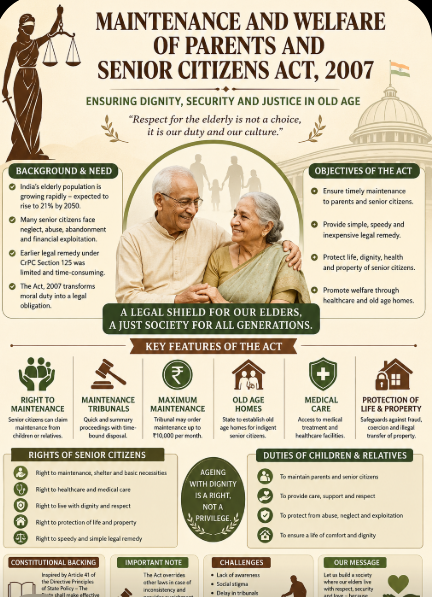
India is kind of a country that is deeply set in family warmth, respect for elders, and a habit of filial piety. For ages, the joint family system basically worked like a support beam for senior people, where the younger lot dutifully cared for their parents and grandparents, all in one home. But now, with […]
Can a Co-Owner Sell or Mortgage an Undivided Share Without Consent?

Can a Co-Owner Sell or Mortgage an Undivided Share Without Consent? A Study of Co-Ownership and Coparcenary Property Under Indian Law Abstract Whether a co-owner of jointly owned or ancestral property can sell or mortgage his or her undivided share without the consent of other co-owners remains a recurring source of litigation in Indian […]
Rights of Senior Citizens to Claim Maintenance from Grandchildren in India: Recent Legal Shifts A Comprehensive Legal Analysis of the Evolving Framework Under the MWPSC Act, HAMA, BNSS, and Supreme Court Jurisprudence

INTRODUCTION India’s elderly population is growing at an unprecedented rate, straining both family structures and the formal legal system designed to protect them. The joint family system—once the default mechanism for elder care—has fragmented. Grandchildren often reside in different cities or countries, complicating direct caregiving relationships. In this context, Indian law has emerged as the […]
From Social Stigma to Legal Protection: The Journey of a Second Wife’s Rights.

By Ishu Tyagi~ Abstract The legal rights of a second wife in India remain a significant and debated issue in family law due to the existence of different personal laws. Under the Hindu Marriage Act, 1955, a second marriage during the lifetime of a legally wedded spouse is generally considered void, whereas Muslim Personal Law […]
Can a Parent Legally Disown Their Adult Child from Self-Acquired Property?

Can a Parent Legally Disown Their Adult Child from Self-Acquired Property? Abstract The increasing prevalence of newspaper notices wherein parents publicly “disown” their adult children has generated significant confusion regarding the legal consequences of such declarations. Many individuals assume that a mere public notice is sufficient to deprive a child of inheritance rights. However, the […]
Uttarakhand’s New Live-In Relationship Registration Rules: What you Need to Know

1. Introduction India has long been a country where personal relationships are governed by a patchwork of religious and customary laws. Live-in relationships, though recognised by the Supreme Court and protected under the Protection of Women from Domestic Violence Act, 2005, have never had a dedicated registration framework — until now. On 27 January 2025, […]
Is an Oral Partition of a Joint Family Property Legally Valid in India? Supreme Court Rulings, the Section 6 Proviso, and the Post-2005 Doctrinal Landscape

I. Setting the Scene: The Quiet Dissolution of Joint Families The oral partition of Hindu joint family property occupies an unusual place in Indian jurisprudence. It is simultaneously a settled legal principle and an active doctrinal fault line valid as a matter of classical Mitakshara customary law, yet insufficient, under the interpretation adopted by the […]
WHAT IS THE LEGAL DIFFERENCE BETWEEN A LEGAL HEIR CERTIFICATE AND A SUCCESSION CERTIFICATE?

What is the Legal Difference Between a Legal Heir Certificate and a Succession Certificate? By Nandani Singh ABSTRACT Legal and administrative matters arise from a person’s death when assets, liabilities, or inheritance rights are being transferred[1]. In situations where property is transferred upon a deceased person’s death, two documents often come into play: the Legal […]
WHAT ARE THE LEGAL PROCEDURES AND GROUNDS TO FILE FOR A MUTUAL CONSENT DIVORCE UNDER CHRISTIAN PERSONAL LAW?

Abstract According to Christianity Marriage is regarded as a sacred covenant a lifelong exclusion union between one man and one woman. It is designed to be an intimate partnership reflecting divine love and in is intended to support , companionship. However, when a marriage has irretrievably broken down and the spouses are unable to continue […]
CAN A DAUGHTER-IN-LAW CLAIM A SHARE IN HER FATHER-IN-LAW’S SELF-ACQUIRED PROPERTY UNDER THE HINDU SUCCESSION ACT?

CAN A DAUGHTER-IN-LAW CLAIM A SHARE IN HER FATHER-IN-LAW’S SELF-ACQUIRED PROPERTY UNDER THE HINDU SUCCESSION ACT? A Critical Legal Analysis Author: Garvita Mishra Statutory Reference: The Hindu Succession Act, 1956 (as amended in 2005) PART I – ABSTRACT Whether a daughter-in-law has a right to claim a share in her father-in-law’s property is a question […]